Imagine a creature that looks like a microscopic, geometric soccer ball made of chalk. It has been floating in our oceans since the age of the dinosaurs, surviving the asteroid impact that wiped out dinos.
For decades, this tiny organism held onto a secret that scientists are calling a once-in-a-billion-year evolutionary event.
Recently, researchers confirmed that this alga did something everyone thought was impossible: it swallowed a bacteria and turned it into a brand-new internal organ, a nitroplast, capable of pulling fertilizer directly out of thin air.
Here is the story of how a 25-year-old genetic mystery, a fragile ocean “diva,” and a crippled piece of DNA completely rewrote the rules of biology.
Certain algae can fix nitrogen, largely through cyanobacteria (historically called blue-green algae). A monumental 2024 discovery revealed that a single-celled marine alga (Braarudosphaera bigelowii) evolved an organelle called a nitroplast to pull nitrogen directly from the air.
- Free-Living or Symbiotic Cyanobacteria: Species like Nostoc and Anabaena are free-living or form symbiotic relationships with other organisms (like fungi in lichens or ferns like Azolla). They fix atmospheric nitrogen into usable ammonia using specialized cells called heterocysts.
- The Nitroplast Organelle: This is the first known eukaryote to integrate a nitrogen-fixing bacterium directly into its cell structure. The alga relies on the nitroplast to fix nitrogen just as plants rely on chloroplasts to fix carbon
Step 1: The Invisible Ghost in the Water
Our story begins in 1998. Marine scientist Dr. Jonathan Zehr was analyzing Pacific ocean water when his equipment picked up a strange, unidentifiable fragment of DNA. It belonged to a nitrogen-fixing cyanobacterium (a type of ancient bacteria), which he named UCYN-A.
For more than two decades, UCYN-A was a ghost. Scientists could find its DNA in the water, but they could never see the organism itself. They assumed it was a free-living, independent bacteria that occasionally hitched a ride inside a larger host.
But there was a massive problem: nobody could catch the host.
Step 2: Capturing the Ocean’s Fragile Diva
The host organism was Braarudosphaera bigelowii, a single-celled marine alga. Under a microscope, it looks like a beautiful armor-plated sphere covered in twelve star-shaped chalk plates.
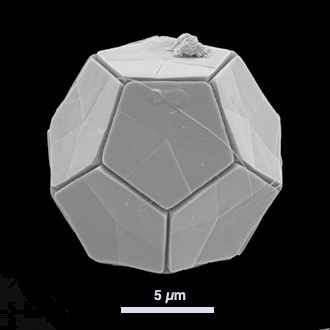
Because of its rigid, delicate chalk shell, it is an absolute diva to grow in a lab. Paleontologist Dr. Kyoko Hagino spent over a decade going on 300 different ocean expeditions trying to harvest them. Every time they brought them to the surface, the cells would break apart and die.
It wasn’t until teams finally perfected a recipe for artificial seawater that they successfully kept the alga alive in a lab. And that is when the ghost finally appeared. UCYN-A wasn’t just hitching a ride inside the alga. It was trapped inside it.
Using advanced X-ray imaging, scientists watched the cells multiply. Whenever the host alga split in two, UCYN-A divided at the exact same millisecond. They were operating as a single unit.
Step 3: The Broken Instruction Manual
The definitive proof came down to a numbers game hidden inside the DNA.
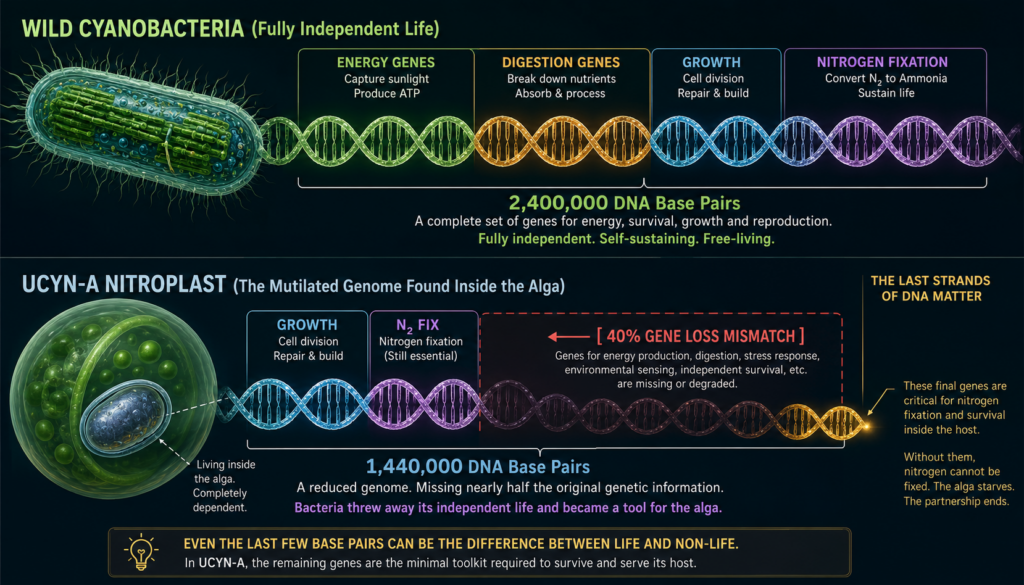
Every independent living creature has a full genome—a massive instruction manual containing all the genetic chapters needed to grow, eat, breathe, and reproduce. A normal, free-living cousin of this bacteria has an instruction manual about 2,400,000 DNA letters long.
But when scientists read UCYN-A’s manual, they found it was completely ruined:
Free-Living Cyanobacteria (Full Instruction Manual)
[=== Energy ===][=== Digestion ===][=== Growth ===][=== Nitrogen Fixation ===]
~ 2,400,000 DNA Base Pairs

The Nitroplast Organelle (Stripped-Down Manual)
[  MUTILATED  ][  MUTILATED  ][=== Growth ===][=== Nitrogen Fixation ===]
~ 1,440,000 DNA Base Pairs
The nitroplast had discarded nearly 40% of its total DNA. It threw away the chapters on how to digest food, how to build its own cell wall, and how to process energy. If you threw this bacteria out into the wild ocean today, it would die instantly.
It kept only the chapters required to do one specific job: suck nitrogen out of the air and turn it into usable food.
Step 4: The Cellular Delivery System
Because the nitroplast threw away its vital genes, it relies entirely on the host alga to keep it on life support. This requires a highly sophisticated, automated delivery system.
When the nitroplast needs a tool to survive, the host alga manufactures it in the main cell body. But how does the protein find its way into the right organelle? It uses a genetic barcode system:
HOST ALGA NUCLEUS
Generates Vital Protein Piece
▼
Attaches DNA “Zip Code” Tag
▼
CYTOPLASM (CELL BODY)
Protein Floats to the Nitroplast
▼
NITROPLAST MEMBRANE
Recognises Tag > Opens Gate
▼
NITROPLAST INTERIOR
Uses Protein to Fix Nitrogen
The host alga pastes a specific amino acid tail (a molecular “Zip Code”) onto the protein. The cell detects this shipping label, transports it across the cell body, and the nitroplast reads the label, opening its outer wall to swallow the package.
This exact “Zip Code” system is identical to how human cells communicate with our own mitochondria. It is the final evolutionary proof that this bacteria is no longer a separate organism. It has officially graduated into a permanent organelle – the nitroplast.
Why This Changes Everything
This is only the fourth time in the entire 4-billion-year history of Earth that primary endosymbiosis, an organism swallowing a bacteria and turning it into an organelle, has ever been proven to happen. It is the exact evolutionary process that gave us plants (when an ancient cell swallowed a carbon-fixing chloroplast).
By understanding how this tiny chalk soccer ball ships proteins to its nitroplast using molecular zip codes, scientists are already brainstorming the future. If we can copy this exact genetic shipping system, we might one day engineer crops like corn, wheat, or rice to grow their own nitroplasts.
That means crops that fertilize themselves directly from the air, completely eliminating the need for chemical fertilizers and changing global agriculture forever