For years, businesses have relied on digital advertising to reach customers. Platforms such as Google, Facebook, Instagram, LinkedIn, TikTok and X have built trillion-dollar industries around the promise of connecting brands with real people.
But a growing question is emerging.
What happens when much of the internet is no longer made up primarily of humans?
Artificial intelligence is changing the internet at an unprecedented pace. AI systems are creating articles, social media posts, product descriptions, videos, comments, reviews, images and even entire websites. At the same time, automated bots crawl, monitor, index, analyse and interact with online content every second.
The result is an internet that increasingly serves machines as much as people.
The Rise of AI Generated Content
Only a few years ago, producing large amounts of content required teams of writers, designers and marketers.
Today, a single AI model can generate hundreds of blog posts, thousands of product descriptions and an endless stream of social media content within hours.
This has dramatically lowered the cost of publishing content while massively increasing the amount of information available online.
The challenge is that quantity does not always equal quality.
Search engines, social media platforms and users are now flooded with content, making it increasingly difficult for genuinely valuable information to stand out.
Bots Are Everywhere
Bots are not new.
Search engine crawlers have existed for decades. Security scanners constantly test websites for vulnerabilities. Price comparison bots monitor online stores. Social media platforms use automated systems to detect spam.
Today, the number of bots has exploded.
Modern bots include:
- AI search crawlers
- SEO analysis tools
- Website monitoring services
- Cybersecurity scanners
- Social media automation tools
- AI research agents
- Shopping comparison bots
- Large Language Model crawlers
Many websites now receive significant traffic from automated systems rather than human visitors. Not all bots are malicious. In fact, many perform useful functions that help keep the internet operating efficiently.
However, they still consume bandwidth, inflate traffic statistics and complicate marketing analytics.
Are Your Ads Being Seen by Humans?
This is one of the biggest questions facing advertisers today.
Most advertising platforms invest heavily in detecting invalid traffic and click fraud. They continuously improve systems designed to identify suspicious behaviour and remove fraudulent impressions or clicks from billing.
Even so, no system is perfect.
Businesses should ask several important questions.
- How much of my website traffic comes from real people?
- How many ad impressions are genuinely viewed by humans?
- Are automated systems inflating engagement metrics?
- Are accidental clicks reducing advertising performance?
- How much budget is lost to invalid traffic?
The larger and more automated the internet becomes, the more important these questions become. And lets be real – Meta wont really care if it’s real or bot – they get paid either way.
AI Is Changing Search Behaviour
Traditional search engines are also evolving.
Instead of clicking through multiple websites, users increasingly receive AI-generated summaries that answer questions directly.
This means fewer clicks may reach publishers, even if their content helped train or inform those AI systems.
Businesses may need to rethink success metrics.
Instead of measuring only website visits, organisations should also consider:
- Brand visibility
- Authority
- Expert content
- Customer trust
- Community engagement
- Direct customer relationships
The Explosion of Synthetic Content
One of the most significant shifts is the sheer volume of synthetic content now entering the web every day. While this improves productivity, it also creates information overload.
Consumers are becoming more selective about who they trust.
Authenticity is rapidly becoming a competitive advantage.
Automated Traffic vs Human Traffic
According to Imperva’s annual 2026 Bad Bot Report, automated traffic has been steadily increasing over the last decade.
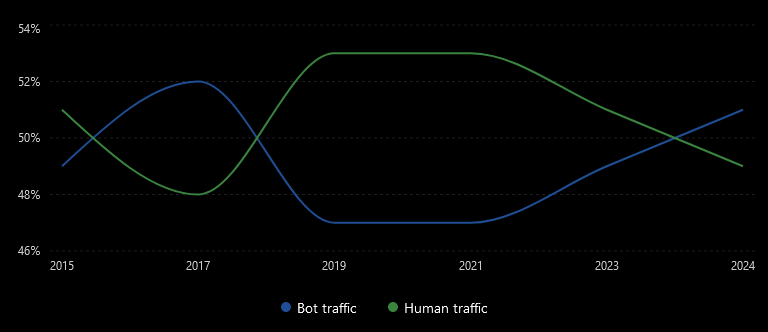
Values are rounded estimates compiled from annual industry reports and illustrate the overall direction of change, not exact yearly measurements.
Key takeaway: In 2024, automated traffic was estimated to account for just over half of all web traffic for the first time in more than a decade. This trend will now continue rising as tech companies fight for dominance.
AI Content Production Growth
No one knows exactly how much content online is AI-generated, but virtually every study agrees on the direction.
Estimated share of new online content assisted by AI. Illustrative industry trend showing the rapid adoption of generative AI for publishing.
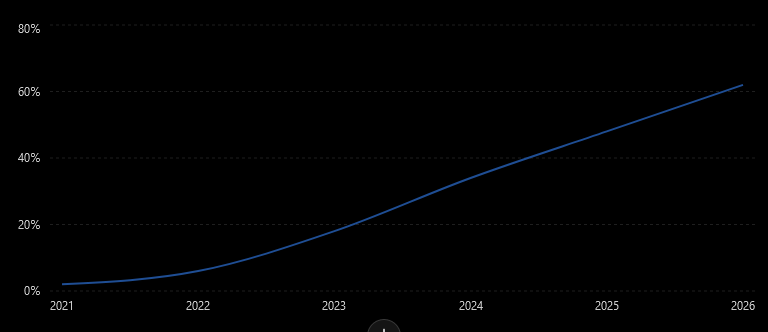
Figures are indicative based on multiple industry surveys and should be interpreted as directional rather than definitive.
Key takeaway: AI-assisted content creation is growing exponentially. Many marketing teams now use AI somewhere in their content workflow, even when a human editor reviews the final copy.
Measure What Matters
Traffic alone is becoming a weaker measure of success. Views and some clicks are pretty much impossible to tell if it was bot or human.
Businesses should instead monitor:
- Qualified leads
- Sales conversions
- Customer retention
- Returning visitors
- Time spent engaging with valuable content
- Email subscribers
- Brand mentions
- Customer satisfaction
High-quality engagement from real customers is far more valuable than thousands of anonymous visits.
The Future Internet Will Be Shared
The internet is no longer just a place where humans communicate.
It has become an ecosystem where humans and machines continuously interact. AI agents will increasingly search, negotiate, compare products and gather information on behalf of people.
Businesses should prepare for an internet where both human users and AI systems become important audiences.